
For tree nut growers in Australia and New Zealand, the sound of birds in the orchard isn't just nature - it’s the sound of declining profits.
Whether you are growing macadamias, walnuts, hazelnuts, brazil nuts, pecans or almonds, understanding why birds target your crop and which species are the culprits is the first step toward an effective defense.
Why Do Birds Target Tree Nuts?
Birds aren't just looking for a snack; they are looking for survival. Research shows three main reasons for their persistence:
-
- Nutritional Powerhouses: Nuts are packed with unsaturated fats and proteins. For a bird, one nut offers more energy than hundreds of small seeds or insects.
- Seasonal Timing: Nut maturity often coincides with migration or the onset of winter. Birds instinctively seek out high-calorie foods to build fat reserves.
- Caching Instincts: Many species, particularly crows and parrots, are "cachers." They harvest more than they can eat, hiding nuts in tree hollows or the ground for later, meaning they can strip a tree far faster than they can consume the crop.
- Beak Maintenance: Cockatoos have fast-growing beaks that require constant maintenance. Chewing on young wood and flush keeps their beaks sharp and at the correct length.
- Behavioral Habit: Birds are social feeders, so when one bird starts eating the nuts, others in the flock are likely to follow.
So what species are some of the main culprits?
Australia: The Heavy Hitters
Australia faces some of the most intelligent and destructive avian pests in the world:
-
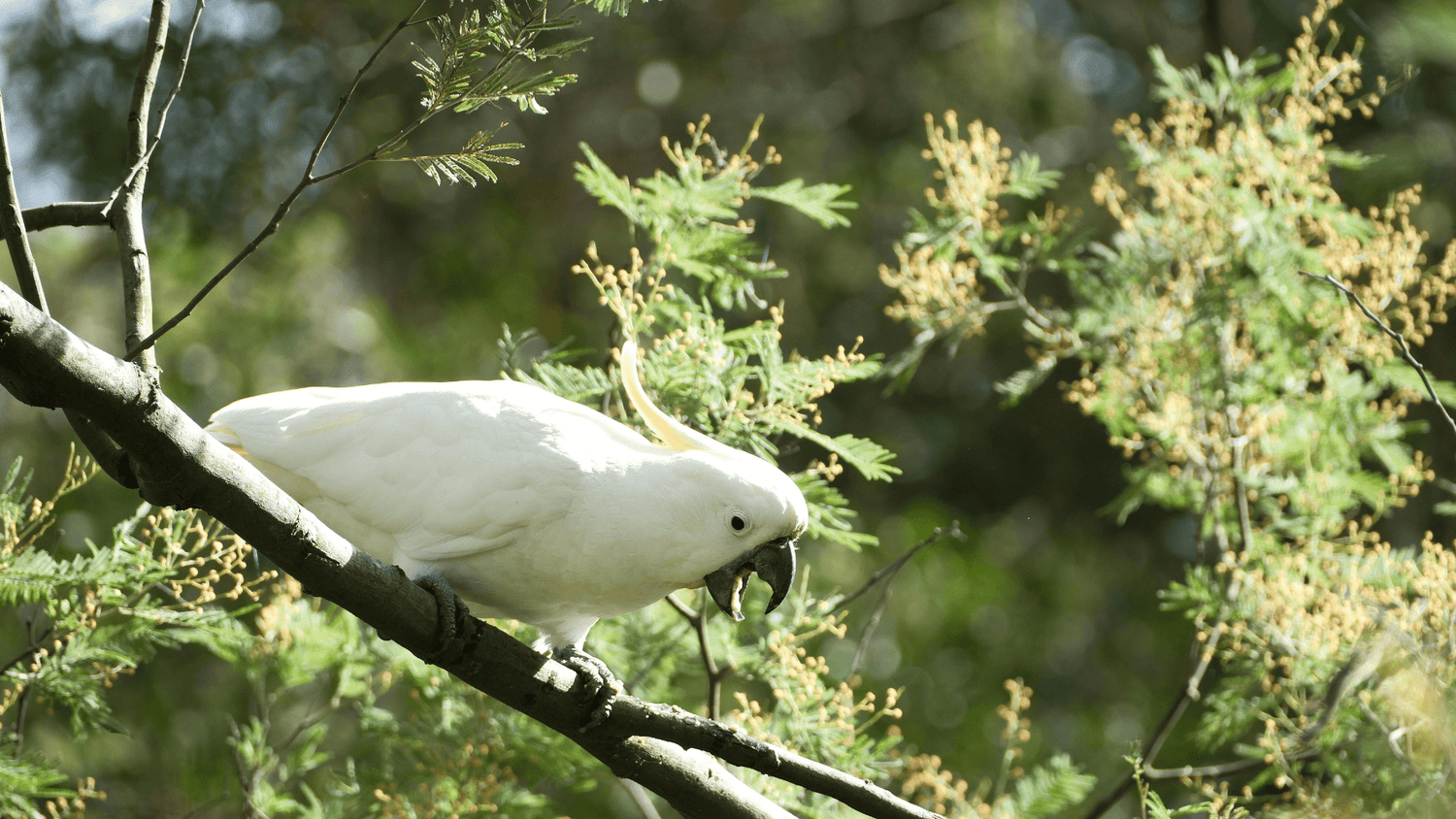
- Sulphur-crested Cockatoos, Black Cocatoos & Corellas: These birds are highly destructive. They don't just eat the nuts; they often destroy branches, flush and chew through irrigation lines.
- Galahs: Known for targeting almonds and grain crops, forming massive flocks that can overwhelm an orchard in hours.
- Australian Ravens (Crows): Extremely smart, they often learn harvest schedules and can bypass simple deterrents quickly.
New Zealand: The "Peckers"
In NZ, the damage is often more subtle but equally costly:
-
- Common Mynas & Blackbirds: These species "sample" the crop, pecking holes in ripening nuts and making them prone to disease or unsellable.
- Eastern Rosellas: An introduced species that has become a major headache for walnut and hazelnut growers across the country.
Comparing Bird Deterrents: What Actually Works?
When choosing a bird control strategy, an Integrated Pest Management (IPM) approach is essential.
Multiple bird deterrents work together having an effect on birds that is far greater than using just one deterrent or another. Using deterrents that target more than one of the birds senses (sight,hearing, taste smell) is more effective.
Birds navigate by sight and communicate with sound. Disrupting both (e.g. use of laser and bioacoustic deterrents together) causes them to feel more threatened than targeting
just their sight or hearing alone.
1. Physical Exclusion (Netting)
-
- The Pros: The only 100% effective method. If they can’t touch the nut, they can’t eat it.
- The Cons: Massive upfront capital cost and high labor requirements for installation and maintenance. For most nut orchards with large trees using netting is highly impractical
2. Shooting (Physical Removal)
-
- The Pros: Noise deterrent as well as a physical danger to the birds. Good way to decrease pest bird numbers.
- The Cons: High risk, labour intensive and a lot of the problem birds are protected species.
3. Automated Lasers (Sight)
-
- The Pros: Create a perceived physical threat. Birds see the green beam as a solid object and flee. It is silent, making it ideal for orchards near residential areas.
- The Cons: Requires a clear line of sight; thick canopies can create "shadows" where birds can hide. Needs to be mounted above the height of the trees.
4. Bioacoustics (Sound)
-
- The Pros: Uses high-fidelity distress calls and predator sounds to create a "danger zone." It targets the birds' natural survival instincts.
- The Cons: If sounds are played on a simple loop, birds may eventually "habituate" (realize there is no real danger).
- The Birdzout Advantage: Our units use randomized digital sound technology to prevent habituation.
5. Visual Decoys
-
- The Pros: Cheap and easy to install.
- The Cons: Very low long-term effectiveness. Birds are intelligent if visuals are not shifted around or used in conjunction with other scarers they could learn to adapt to them.
Birdzout offers a complete range of professional bird deterrents that help growers safeguard the flush and the nuts, save time and reduce losses.
Birdzout Ultimate Laser – Premium Smart Deterrent

Best for: Larger orchards or areas with high bird activity.
The Birdzout Ultimate Laser projects a moving green beam across your crop - perceived by birds as a solid threat, triggering immediate flight.
Covers large orchards from a single location
Operates automatically, even at dawn and dusk when birds are most active.
Silent, continuous deterrence that won’t disturb nearby houses or staff.
Excellent alternative or supplement to netting.
Pro Tip: Mount high above the tops of the trees, on a tripod, stable post or roofline with a clear view down into the trees.
Birdzout Auto Laser 500 – Automated Coverage for Mid-Size Blocks

Best for: Medium-sized orchards or high-value blocks within larger operations.
The Birdzout Auto Laser 500 offers fully automated coverage of up to several hectares, sweeping a programmable zone 24/7.
Solar-powered for remote areas.
Adjustable patterns and schedules to reduce bird habituation.
Proven effective against starlings, blackbirds and silvereyes.
Pro Tip: Use the Birdzout Auto Laser 500 in conjunction with other deterrents (e.g. Predator Kites or Bioacoustics) for stronger layered protection.
Birdzout Bioacoustic System – Realistic Sound Deterrent

Best for: Targeting specific birds species
The Birdzout Bioacoustics system broadcasts species-specific distress and predator calls to create an unsafe environment for birds.
Wide-area coverage with programmable call sequences.
Customisable for the key problem species in your region.
Human-safe and eco-friendly - no harm, just smart deterrence.
Pro Tip: Install Bioacoustics near block perimeters or entry points. Works in well with Predator Kites as the birds associated the sounds with the kite.
Case Study: See how a Macadamia grower successfully protected their crop using our Bioacoustic Unit in this real-world application.
Predator Kite Package – Visible, Natural Threat

Best for: Open areas and edge protection.
The Predator Kite mimics the flight of a bird of prey, creating a powerful visual deterrent that moves naturally in the wind.
Highly visible across long distances.
Simple to install and low maintenance.
Ideal for supplementing lasers or sound systems.
Pro Tip: Place kites along boundary lines or above high-pressure zones. Move periodically to avoid birds learning fixed positions. Ensure the kite is flying above the tops of the trees.
Purivox Gas Guns – Long-Range Deterrent

Best for: Large orchards or high-pressure bird sites.
Purivox Gas Cannons produce controlled loud bangs at set intervals, reinforcing the sense of danger in your crop zone.
Programmable timers and rotation systems available.
Covers large open areas where birds congregate.
Designed for durability and safety in farm environments.
Pro Tip: Set gas guns to fire at 3 shots per cycle with a longer delay interval, for best results.
Don’t Just Wing It - Birdzout Smart Tips for Success
Start Early - Have deterrents in place before birds establish feeding habits - ideally two weeks before the critical bird risk stage.
Combine Methods - Mix laser, sound, and visual tools for stronger deterrent power.
Be Consistent - Maintain deterrents daily - gaps in protection invitebirds back.
Monitor and Adjust - Keep an eye on behaviour changes and rotate tools or positions.
Think Long-term - Invest in durable, automated systems that protect season after season.
Ready to secure your harvest?
Don't wait for the flocks to arrive. Contact the team at Birdzout today for a custom bird control plan tailored to your orchard’s location and problem species